
Beyond the Datasheet: how to Really Evaluate a BESS Supplier
A BESS datasheet can tell you almost everything about a battery system — and still leave out what matters most before you sign. Here's how to evaluate suppliers properly.
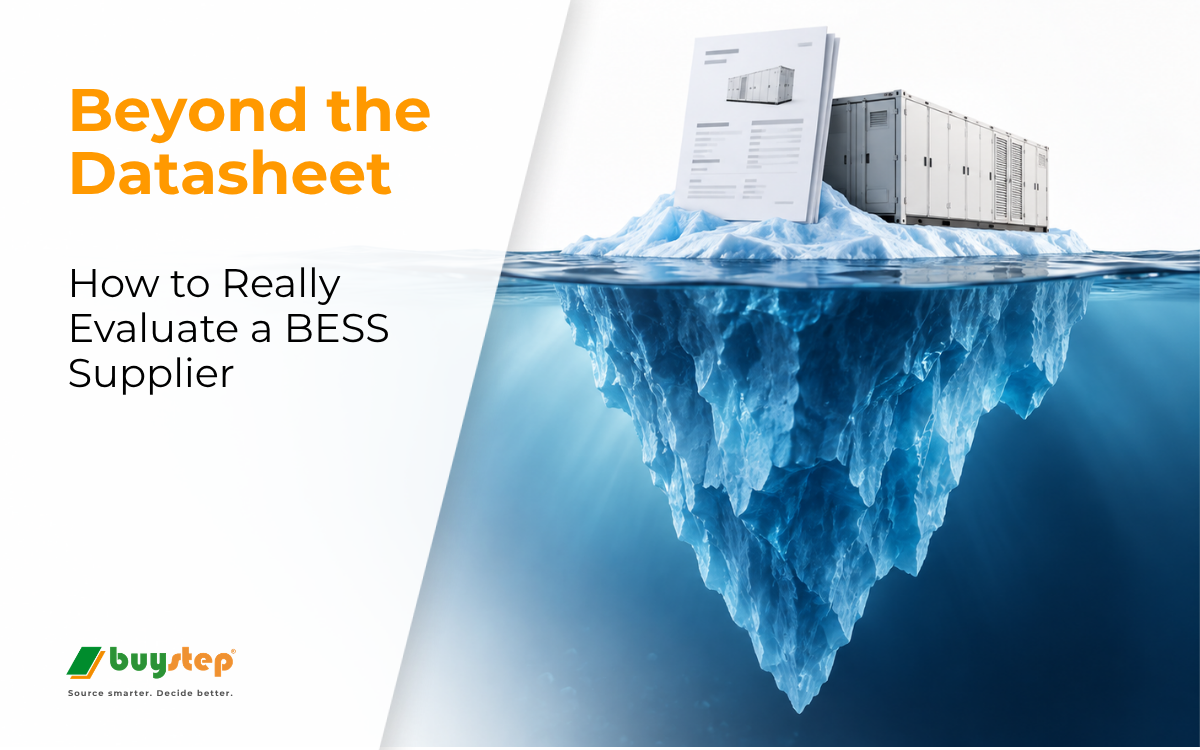
A 10,000-cycle rating means nothing without knowing the test conditions behind it. A "5 MWh" system doesn't guarantee 5 MWh of usable energy.
For a BESS project expected to run for 10 to 20 years, the datasheet is only the starting point — the real differences between suppliers show up in system integration, verified performance, and long-term support, not in headline numbers.
Beyond the Datasheet: How to Really Evaluate a BESS Supplier
A BESS datasheet can tell you almost everything about a battery system — and still leave out some of the information that matters most when you are about to sign a contract.
Capacity, cycle life, round-trip efficiency, operating temperature, warranty period and design life have become standard elements of almost every Battery Energy Storage System (BESS) offer.
The difficulty for professional buyers is no longer finding a supplier that can provide impressive specifications. The real challenge is understanding what those specifications actually mean, under which conditions they have been achieved, and whether they can be verified over the lifetime of the project.
For a BESS project expected to operate for 10, 15 or even 20 years, the datasheet is only the starting point.
The Datasheet Is Not the System
A BESS is not simply a collection of battery cells inside a container. The final performance of the system depends on the interaction between the cells, battery management system, thermal management, DC architecture, power conversion system, energy management system, controls, software and site conditions.
This is why two BESS products using similar LFP cells can still have significantly different operating characteristics, degradation profiles and lifecycle economics. The cell is important. But it is only one part of the system.
For buyers, this distinction is increasingly important as the BESS market becomes more standardized. Cell capacities and container architectures are becoming easier to compare, while differentiation is moving increasingly toward system integration, controls, thermal management, software, service and long-term performance.
In other words, the question is no longer simply which battery is being used, but how the complete system has been designed around it.
Look Behind the Headline Numbers
Consider a typical BESS specification: 5 MWh capacity, 10,000 cycles, ≥90% round-trip efficiency, 20-year design life, operating temperature -20°C to +50°C.
At first sight, this appears to provide a very complete picture. It does not.
The first question should be: under what conditions? A cycle-life figure without its test conditions is difficult to compare. Was the battery cycled at 0.5C or 1C? At what depth of discharge? At what temperature? Within which state-of-charge window? What end-of-life capacity was used?
The same applies to round-trip efficiency.
Is the figure measured at cell level, DC level or AC level? Does it include the PCS, auxiliary consumption, cooling system and other system losses?
Even capacity requires clarification. Is the quoted figure installed energy, nominal energy or guaranteed usable energy?
These distinctions may appear technical, but they can have a direct impact on the economics and contractual performance of a project.
A professional buyer therefore needs to move from the question "What is the specification?" to "What are the conditions behind the specification?"
Cycle Life Is Not a Standalone Number
"10,000 cycles" has become a familiar figure in BESS marketing.
But cycle life is not an independent characteristic that can simply be compared between suppliers.
Battery degradation is influenced by how the system is operated.
Depth of discharge, charge and discharge rates, temperature, state of charge and operating strategy all affect the ageing process. A battery operating under one profile may therefore experience a very different degradation trajectory from an apparently identical battery operating under another.
The European Battery Regulation itself recognizes the importance of operating data. For stationary battery energy storage systems, the regulation identifies parameters such as energy throughput, capacity throughput, harmful events, time spent at extreme temperatures and full equivalent charge-discharge cycles when determining expected lifetime.
For buyers, this reinforces an important principle: a cycle-life claim should never be evaluated independently from the conditions under which it was obtained.
Capacity Is Not the Same as Usable Energy
Another common source of confusion is the difference between nominal and usable capacity.
A system described as a 5 MWh BESS does not necessarily provide 5 MWh of usable energy to the grid under every operating condition.
There may be differences between nominal DC energy, guaranteed usable energy, AC energy delivered and energy available at a particular point in the battery's life. Auxiliary loads and conversion losses also matter.
This becomes particularly important when comparing commercial offers. A lower-priced system with a higher nominal capacity may not necessarily deliver more usable energy over its lifetime than a more expensive system with a different operating window and degradation profile.
For this reason, professional procurement should focus on the energy the system is contractually expected to deliver, rather than relying solely on the nameplate capacity.
The Conditions Behind Performance Matter
Temperature is a good example. Battery performance and degradation are affected by temperature, which means that the statement that a system can operate from -20°C to +50°C does not mean that it will deliver identical performance throughout that range.
The same principle applies to charging and discharging power. A system capable of a particular C-rate may not maintain the same efficiency or degradation profile when operating continuously at that level.
This is why a serious technical evaluation should connect the datasheet to the intended operating profile of the project. A BESS designed primarily for energy arbitrage may have a different duty cycle from one designed for frequency regulation, renewable integration or capacity services.
The procurement question should therefore be: can the supplier demonstrate that the system's tested and guaranteed performance matches the actual operating profile of the project?
From Cell Quality to System Quality
Cell selection is one of the most visible aspects of a BESS. It is also one of the easiest aspects to compare.
The more difficult question is what happens after the cells leave the factory.
How are they monitored? How is thermal behaviour controlled? How is the battery management system designed? How does the PCS interact with the battery? How does the EMS control the operating window? How are abnormal conditions detected? How are software updates managed? And what happens when individual components need to be replaced several years after commissioning?
These questions matter because the BESS is a system, not a collection of independent components.
The European Battery Regulation reflects this system-level approach. Stationary BESS placed on the EU market or put into service must meet safety requirements, with technical documentation demonstrating compliance and evidence of appropriate safety testing.
For buyers, the implication is clear: supplier evaluation should extend beyond the battery cell and into the architecture and evidence supporting the complete system.
Ask for Evidence, Not Only Declarations
There is an important difference between a supplier saying that a system has a particular performance characteristic and being able to demonstrate it.
This does not mean that every supplier claim is questionable. It means that a professional procurement process should distinguish between a specification, a test result, a contractual guarantee, and an operational track record. These are not interchangeable.
A datasheet is a supplier's description of its product.
A test report provides evidence under defined conditions.
A contractual guarantee establishes an obligation.
An operational reference demonstrates how the technology has performed in the field.
The strongest procurement decisions use all four.
Field Experience Matters
A supplier may have an excellent product and still be relatively new to large-scale BESS deployment. Conversely, an established manufacturer may have extensive battery experience but limited experience with a particular BESS architecture, market or application.
This is why references should be examined in context.
The relevant question is not simply "how many MWh has the supplier delivered?" It is "how many comparable systems are operating, for how long, under what conditions, and with what level of performance?"
A 10 GWh manufacturing capacity and a 10 GWh operating track record are obviously not the same thing. Nor is manufacturing capacity necessarily evidence of long-term service capability.
The Supplier Is Part of the BESS
A BESS project does not end when the container arrives at the site.
The system may require software updates, spare parts, remote monitoring, maintenance, troubleshooting and potentially component replacement for many years. This makes the supplier's long-term capability part of the technical evaluation.
Who will provide support after commissioning? Where are critical spare parts located? Who controls the software? What happens if a component becomes obsolete? Can a cell, BMS component, PCS or other critical element be substituted? Will the buyer be informed before a change is made?
These questions may not appear prominently on a technical datasheet, but they can have a significant impact on the lifecycle of the asset.
Warranty and Performance Should Be Evaluated Together
The same principle applies to warranties. A supplier may offer a 10-year warranty, but the number of years alone does not tell the buyer what is actually guaranteed.
Capacity retention, energy throughput, availability, operating conditions, temperature limits and other contractual conditions can all affect the practical value of the warranty. The warranty should therefore be read together with the technical specification and the expected operating profile.
This is particularly important for projects where the BESS business case depends on predictable performance over many years. A warranty is not simply a document protecting the buyer against equipment failure. It is part of the overall definition of the performance that the supplier is prepared to stand behind.
A Better Way to Compare BESS Suppliers
For professional buyers, the objective should not be to find the supplier with the most impressive datasheet. It should be to establish whether the supplier can provide credible, comparable and verifiable evidence for the performance required by the project.
That means moving progressively through four questions:
What does the supplier claim?
Under which conditions?
What evidence supports the claim?
What is actually guaranteed contractually?
This approach changes the procurement process. Instead of comparing isolated numbers, the buyer starts comparing the quality of the evidence behind those numbers. And that is often where the real differences between BESS suppliers become visible.
The Datasheet Is Only the Beginning
The BESS industry is moving toward greater standardization. Cells are becoming larger and more standardized. Container capacities are increasing. System architectures are becoming more familiar. At the same time, regulatory requirements around safety, performance, information and traceability are becoming increasingly important in the European market.
As a result, simply comparing headline specifications will become less useful. The competitive difference will increasingly be found in the details: system integration, verified performance, degradation management, software, service capability, documentation, warranty structure and long-term support.
For buyers, this means that the most important document in a BESS procurement process may not be the datasheet. It may be the evidence behind it.
A datasheet tells you what a supplier says its BESS can do. Due diligence tells you what you can reasonably expect it to do. And for a battery storage project expected to operate for a decade or more, that distinction can be worth far more than a few euros per kWh.
This article is part of BuyStep's BESS Procurement Insights series, focused on helping professional buyers evaluate battery and energy storage suppliers beyond headline specifications.
By Thierry C.