
The Most Common Mistakes in Energy Storage Sourcing
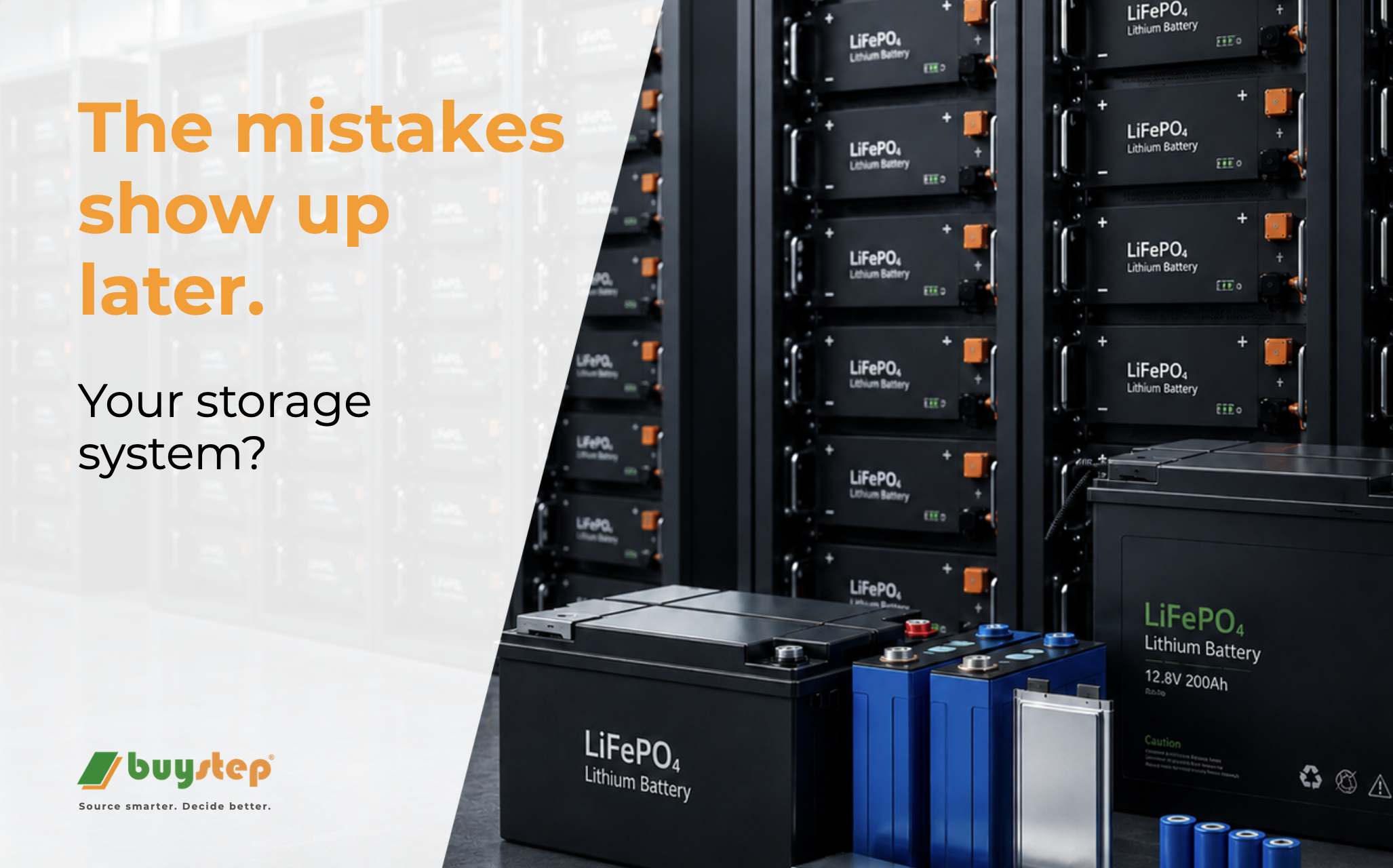
The Most Common Mistakes in Energy Storage Sourcing
In energy storage, the costliest mistakes are almost never visible at the moment of purchase. They show up later — during installation, during the first load cycles, or years after commissioning.
That's exactly what makes stationary battery sourcing far more complex than a simple technology purchase. According to BloombergNEF, deployed storage capacity should grow massively over the coming years, driven by renewables, industrial electrification, and grid stabilization. But this rapid growth hides a more sensitive reality: the gaps in robustness between suppliers are becoming considerable.
The real question is no longer "which battery performs best?" It becomes: "which solution will still be stable, maintainable, and operable in ten years despite industrial and regulatory tension?"
Energy Storage Is Far Less Standardized Than It Looks
The market often gives an impression of standardization: similar spec sheets, comparable certifications, similar advertised performance. This reading is misleading.
In industrial reality, a storage system's reliability depends on a much broader set of factors: system architecture, BMS quality, thermal management, control software, industrial maturity, supply chain, and the supplier's operational stability. Two solutions with similar performance on paper can produce radically different results after a few years of operation — and the difference often comes from software, thermal control, or overall industrial robustness rather than the cells themselves.
Mistake #1: Comparing Only Theoretical Capacity
This is probably the most common mistake.
Many companies still mainly compare energy capacity, density, or theoretical performance advertised by suppliers. But real performance changes over time: cell aging, thermal stress, charge cycles, and environmental conditions all shape actual system behavior.
Two solutions with similar capacity at installation can perform very differently after a few years — in some industrial projects, real profitability has been badly hurt by faster-than-expected performance loss.
The most advanced organizations now look much more at field data, operational history, and long-term feedback.
Mistake #2: Underestimating the Role of the BMS
The Battery Management System is still widely undervalued in many projects, yet it's one of the most critical elements of the whole system. It manages safety, thermal control, cell balancing, lifespan, and overall performance stability.
In several recent stationary storage incidents, the most critical problems came more from control software, algorithms, or thermal management than from the cells themselves.
A system using high-performing cells can still become unstable if the BMS lacks maturity. The most experienced companies now evaluate software quality, architecture stability, supervision capability, and energy control robustness with the same rigor as the electrochemical components.
Mistake #3: Reducing the Decision to Purchase Price
In many tenders, price is still the center of the decision. That logic becomes extremely risky in energy storage.
A very aggressive supplier may be compensating with more variable quality, a more fragile supply chain, strained industrial capacity, or weaker technical support. The real cost of a storage system goes far beyond its purchase price.
The most resilient organizations now think in terms of total risk cost, including maintenance, operational availability, replacement costs, software stability, and supply chain impact. In some BESS projects, corrective costs linked to downtime have far exceeded the savings made at sourcing.
Mistake #4: Neglecting Component Traceability
Traceability is becoming a strategic subject in batteries. Supply chains are extremely complex and involve multiple layers of industrial subcontracting — yet many companies still have limited visibility into cell origin, critical materials, electronic components, or real geographic dependencies.
This opacity sharply increases the risk of supply disruption, regulatory non-conformity, and ESG weaknesses. With new European regulations around the battery passport, being able to demonstrate traceability is becoming essential.
The most advanced companies now build much more structured supply chain mapping.
Mistake #5: Underestimating Technical Support
Technical support is still insufficiently analyzed during sourcing. Yet in energy storage, support quality directly shapes availability, operational continuity, and project stability over many years.
Some companies focus almost exclusively on the delivery phase — but the real challenges appear afterward: maintenance, software updates, parts availability, or international technical assistance.
A technically competent supplier can quickly become problematic without a robust after-sales organization. In critical infrastructure, support continuity becomes a direct indicator of supplier bankability.
Mistake #6: Ignoring Real Industrial Maturity
The storage market attracts many emerging players with very promising technology. But in batteries, the ability to industrialize durably is often more important than maximum theoretical performance.
Some companies still run on unstable industrial processes, limited capacity, or poorly controlled scale-up. In several international projects, the biggest difficulties didn't come from the technology itself — they came from industrial delays, line saturation, or fragile logistics chains.
The most advanced organizations now dig deeper into process stability, industrial redundancy, line flexibility, and a supplier's real ability to absorb strong growth.
Mistake #7: Depending on a Single Supplier
Single-sourcing is becoming one of the main vulnerabilities in energy storage. Global concentration of production capacity sharply increases exposure to geopolitical tension, logistics disruption, and industrial trade-offs.
A company heavily dependent on one supplier becomes mechanically more exposed to delays, shortages, or quality tension.
The most resilient organizations are gradually building multi-source strategies to secure their supply — not necessarily to split volumes right away, but mainly to qualify credible alternatives that can be activated quickly if needed.
Mistake #8: Treating ESG as a Secondary Topic
In batteries, ESG is now a major industrial and financial issue. Investors and buyers pay growing attention to traceability, carbon footprint, and social practices across supply chains.
A supplier with significant ESG weaknesses can create reputational risk, financing difficulties, or future regulatory constraints.
In some financed energy projects, ESG requirements are now nearly as important as technical performance itself. ESG can no longer be treated as a simple documentation requirement — it's becoming a direct indicator of supplier stability.
Mistake #9: Underestimating Technological Obsolescence
The storage market evolves extremely fast: new chemistries, evolving software, optimized system architecture, and improving energy density regularly reshape industrial standards. This creates real risks: quickly outdated solutions, limited compatibility, or reduced long-term support.
Storage sourcing now needs a much broader lifecycle view — the goal isn't just buying a high-performing solution today, but identifying infrastructure able to stay relevant over time.
Traditional Procurement Approaches Are No Longer Enough
This is probably the most structural point.
In many companies, storage sourcing is still largely driven by spec sheets, certifications, and advertised prices. In such a complex energy environment, that logic is becoming obsolete.
The most advanced companies now build much broader approaches integrating industrial robustness, supply chain resilience, financial stability, software maturity, and dynamic supplier monitoring. The real challenge is no longer just comparing batteries — it's securing critical energy infrastructure over several decades.
BuyStep® Turns Storage Sourcing Into a Strategic Risk-Steering Infrastructure
In modern energy projects, the difficulty is no longer accessing battery suppliers. The real challenge is quickly identifying the partners able to stay stable despite industrial tension, regulatory constraints, supply chain volatility, and the fast pace of the global energy market.
That's exactly the logic behind BuyStep®. Rather than a simple energy marketplace, BuyStep® acts as a strategic supplier intelligence infrastructure, helping industrial players steer their storage decisions through a data-driven, multi-risk approach: dynamic supplier scoring, supply chain visibility, industrial robustness analysis, energy qualification, risk monitoring, and operational stability assessment.
The goal is no longer simply selecting a high-performing technology — it's durably securing projects, financing, and future energy continuity.
Conclusion
Energy storage sourcing has become a major strategic issue in modern energy infrastructure. The most common mistakes usually come from an oversimplified view of the market: excessive focus on price, overconfidence in theoretical performance, or underestimating industrial and supply chain risk.
In an energy environment under permanent tension, real performance no longer depends only on the chosen technology — it depends on the ability to select suppliers capable of maintaining their industrial, financial, and operational stability over time. Companies able to structure this approach will hold a major competitive advantage in securing their future energy projects.
作者 Thierry C.